Beyond The B’Nai Mitzvah: Why the Journey Begins at 13
There is no moment quite like it: the proud parents wiping away tears, the grandparents glowing from the front row, and a 12- or 13-year-old standing before the congregation, chanting ancient text with poise and purpose. The d’var Torah is delivered, the mazel tovs echo through the sanctuary, and the party that follows is unforgettable.
Yet, for decades, Jewish educators across America, myself included, have watched a troubling pattern unfold in the months after the music stops. The passion, commitment, and presence that built up to that milestone often vanish.
Why has the Bar or Bat Mitzvah come to be viewed as a graduation ceremony rather than a matriculation? How did we convince ourselves that at age 13, a child has “completed” their Jewish education?
This question keeps me up at night.
The Illusion of “Completion”
Somewhere along the line, the narrative shifted from becoming a Jewish adult to completing a rite of passage. We treat the milestone like a driver’s license or a diploma—a box to check, a performance to execute, and a task to finish.
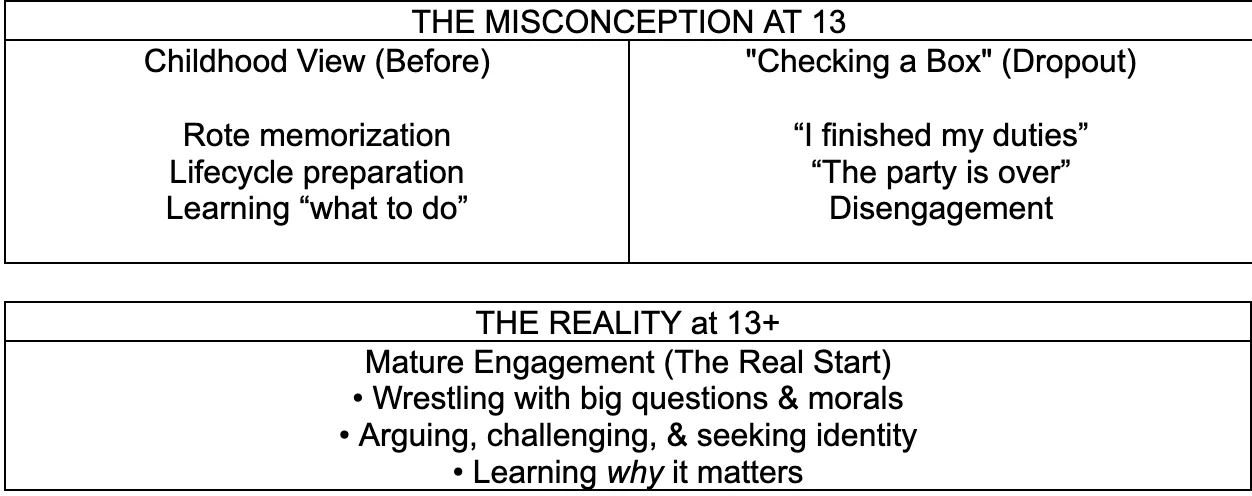
When teens drop out post-Bar/Bat Mitzvah, it usually means they are walking away with a 12-year-old’s understanding of a 3,000-year-old tradition. A child’s Jewish education naturally focuses on foundational stories, basic prayers, and life-cycle preparation. But at 13, the human brain undergoes a massive shift.
Thirteen is not when Jewish learning ends; it is precisely when real Jewish learning begins.
It is at this age that young people stop learning for a milestone and start wrestling with the world. They begin asking complicated questions about morality, identity, justice, and God. They learn to argue, challenge, become stubborn, and find their own authentic voice. Judaism is explicitly built for this kind of intellectual and spiritual wrestling—yet so few stay around long enough to experience it.
Why do so few see this added value? What does it say about how we, as a community, communicate the purpose of our heritage?
It tells us that we have accidentally framed Judaism as a performance rather than a living system designed to add deep meaning, resilience, and grounding to our modern lives.
Moving Past “One-Size-Fits-All”
At Temple Beth Am, we refuse to accept that any single path works for everyone. We do not believe in one-size-fits-all Judaism. Every individual’s journey is different, which is why we have built a landscape designed to meet every member, young and old, deeply practicing or culturally secular, right where they are:
Diverse Shabbatot: Expressive, diverse prayer styles ranging from traditional, reflective services to contemporary, music-driven experiences.
Teen Programs for Real Life: High school offerings that go far beyond the classroom, including options for college credit, hands-on social justice work, and immersive trips.
Engaged Social Action: Projects that allow teens to apply Jewish values to pressing modern problems, turning theology into tangible impact.
Relevant Torah & Discussion: Group learning centered on contemporary ethics, mental health, relationships, and identity.
Despite these open doors, some still choose to step off the path at the very first intersection.
An Invitation to Keep Walking
Judaism is not a stage show where you take your bow at 13 and step behind the curtain. It is an ongoing, lifelong conversation. It is a roadmap for navigating life’s ups and downs, an anchor in a chaotic world, and a community that holds you through every chapter.
To the parents, grandparents, and teens standing at that 13-year-old milestone: do not stop at the first intersection.
The view gets so much better further up the road. I invite you to continue the journey beyond 13, and I promise you it is a path that will take you, your family, and your mind to higher places.
Tamara Donnenfeld